.............. News .............. ............... News ................ .............. News ..........
 If anyone has any other news regarding updated technical information relevant to the identification or naming of bamboos cultivated in western horticulture, especially temperate Asian ones, please submit it to me for inclusion If anyone has any other news regarding updated technical information relevant to the identification or naming of bamboos cultivated in western horticulture, especially temperate Asian ones, please submit it to me for inclusion
May 2021: Reconsideration of Fargesia
Following the new phylogenetic information on Yushania & Fargesia (see below), in this paper the morphological boundaries of genera are considered, and different potential approaches to recognition of genera in this group are discussed.
It is now quite a while since I suggested that the genus Fargesia, with dense unilateral racemes, was only found in the mountains of Central China, and described another genus for clump-forming temperate species from the Himalayas and W China, Borinda. There were difficulties in assessing dozens of Chinese species for placement in either Fargesia or Borinda when the flowers of many were still not known, but new molecular tools for placing these species appropriately without flowers now makes it easier to complete the task. After the outstanding new molecular research (see below), new combinations in Borinda can made for those who wish to recognise that genus, including several more species already in cultivation in the west.
At the same time the molecular investigations have concentrated attention on a further group of species misplaced in Fargesia, which are actually closer to the thorny genus Chimonocalamus. The introduction to the west of 2 such species from China as seed, both sent as Fargesia fungosa, necessitates a further generic name to accommodate them for those who wish to separate Borinda from Fargesia, now that they are so widely grown. It is a pleasure to publish the genus Tongpeia in honour of the bamboo taxonomist from China who has described so many of the species in this group, Professor Yi Tong-Pei, who I met in Hangzhou in 1985 when he was working on species just north of the Tibetan border, while I was working on species south of the border. Because there seems to be some confusion in China as to the characteristics of Tongpeia fungosa, and even more confusion about the specific identity of the seed sold to the west, the new introductions are described in detail under new names. Hopefully this will concentrate attention on the clarification in China of the 3 species and their separation or synonymy.
May 2020: ddRAD Sequencing--monophyly of Yushania and polyphyly
of Fargesia
doctoral dissertation and paper in Journal of biogeography
Important phylogenetic research, undertaken by Dr Ye Xia-Ying in Kunming, has still only been reported in a paper that concentrated upon the correlation between diversification and orogenic activity instead. Admirable and important biogeographic conclusions aside, this paper reported ground-breaking results that expanded upon earlier findings (Wang et al. 2017), but used a more powerful technique of analysis, double digest restriction-site associated DNA sequencing, and included a greatly increased number of species, representing an impressive 79% of known species diversity in this large group.
The results were particularly startling in how well all the species with long rhizome necks (Yushania sensu stricto) were separated from all clump-forming species (Fargesia sensu lato). The Fargesia species were broken down into 5-6 groups. One of these was very well separated and contains the core spathed-flowered species such as F. nitida and others that are morphologically very close to type species. Another corresponded to Borinda, and was more closely related to Yushania. The rest, mostly like Borinda in their possession of both short rhizomes and open inflorescences, were found to be more closely related to Chimonocalamus. They probably included a few species in western cultivation with somewhat speculative identities and problematic generic placement on account of anomalous characteristics. These are 1) Borinda fungosa from Prof Xue, 2) Borinda fungosa etc from internet seed, 3) Fargesia/Yushania yunnanensis, and 4) Borinda lushuiensis collected in Yunnan by Shanghai Botanic Garden in 1995. From these research findings, it would appear to be likely that they would be more satifactorily placed in a new genus, or new genera, along with Yushania boliana, from somewhere in China via Japan, which resolved with Fargesia/Yushania yunnanensis in Kew/Dublin results from 2001.
While Borinda has been recognised by some on mainly morphological grounds, earlier molecular analyses had failed to support its separation from Fargesia or Yushania. This had led to the conclusion by others that the group was not natural, representing part of a range of continuous variation, merging into Yushania or Fargesia or both, or simply the result of subjective unnatural prioritisation of particular morphological characters, in this case the long rhizome necks. Consequently broad treatments of Fargesia or Yushania were followed, and species of Borinda were included in either one or the other. Dr Ye et al. sequenced 29 species from Yunnan, published as species of Fargesia, that resolved in a clade along with most of the species currently placed in Borinda, including the type B. macclureana. Their results also suggested that 3 of the 23 species for which combinations in Borinda have been published, are not likely to belong in that genus, namely Borinda fungosa, B. hsuehiana, and B. lushuiensis.
The results of this research, first submitted for publication in 2018, have still not been properly considered by their authors in the light of their great phylogenetic value, but are discussed in more depth in the page here on Borinda.
Ye, Xia-Ying, Ma, Peng-Fei, Yang, Guo-Qian, Guo, Cen, Zhang, Yu-Xiao, Chen, Yun-Mei, Guo, Zhen-Hua and Li, De-Zhu (2019). Rapid diversification of alpine bamboos associated with the uplift of the Hengduan Mountains. Journal of Biogeography 2019; 00: 1– 12 https://doi.org/10.1111/jbi.13723
.
March 2020: New record for Bhutan - Bambusa pallida
paper in Journal of The American Bamboo Society
In 1991 my time in Bhutan was drawing to a close and the enumeration of the Himalayan bamboos was all written up for my thesis. I was getting ready to move back to the UK, when the inevitable happened. Driving along a winding road towards the Indian plains it was getting dark and starting to rain as the sun slanted from behind the clouds. The dry cosy hotel with a hot meal beckoned. Suddenly, from behind the bushes below the road some dramatic spears were shooting up into the evening sun. Slamming on 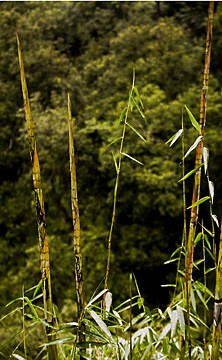 the brakes and reversing back around the bend, I pondered what to do, then compromised. Leaning out of the window I quickly took some the brakes and reversing back around the bend, I pondered what to do, then compromised. Leaning out of the window I quickly took some 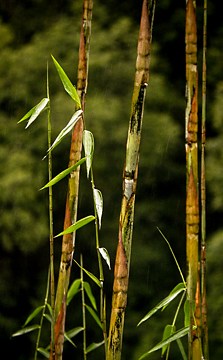 photos, and then drove on when the magical moment had passed. I'll have to come back for that one another time I said to myself. The films were later developed and the photos looked at many times. They continued to haunt and tease me over the years. Boosted by the dramatic lighting and Agfachrome slide film colours, they were as dramatic as my memories of the encounter. Decades came and went but the pictures would not go away. Then after nearly 30 years, I started to work with a keen student who was writing his BSc degree thesis in Eastern Bhutan on one of my favourite bamboos, Neomicrocalamus andropogonifolius. Sangay then moved down to Samdrup Jongkhar and sent me some pictures of a mystery bamboo that he had found, but could not identify from my enumeration. Going carefully through all the possible candidates, we eventually decided that it was Bambusa pallida, a useful medium-sized bamboo that is found from Assam to Thailand. We have just published this as a new record for Bhutan in the Journal of the American Bamboo Society 30:1-5. Is this the bamboo I saw so long ago? I think so, but there are still so many poorly described or undescribed bamboos in NE India and Burma that it is hard to be really sure. At least now I can give it a name and stop pondering about that one as I wander through the forests of Bhutan again and again in my dreams. Still a few others to deal with though, and Sangay keeps finding more! photos, and then drove on when the magical moment had passed. I'll have to come back for that one another time I said to myself. The films were later developed and the photos looked at many times. They continued to haunt and tease me over the years. Boosted by the dramatic lighting and Agfachrome slide film colours, they were as dramatic as my memories of the encounter. Decades came and went but the pictures would not go away. Then after nearly 30 years, I started to work with a keen student who was writing his BSc degree thesis in Eastern Bhutan on one of my favourite bamboos, Neomicrocalamus andropogonifolius. Sangay then moved down to Samdrup Jongkhar and sent me some pictures of a mystery bamboo that he had found, but could not identify from my enumeration. Going carefully through all the possible candidates, we eventually decided that it was Bambusa pallida, a useful medium-sized bamboo that is found from Assam to Thailand. We have just published this as a new record for Bhutan in the Journal of the American Bamboo Society 30:1-5. Is this the bamboo I saw so long ago? I think so, but there are still so many poorly described or undescribed bamboos in NE India and Burma that it is hard to be really sure. At least now I can give it a name and stop pondering about that one as I wander through the forests of Bhutan again and again in my dreams. Still a few others to deal with though, and Sangay keeps finding more!
July 2019: New combinations in Sarocalamus
paper in Nordic Journal of Botany
Sarocalamus has been widely recognized in the west, but has remained in synonymy within China. This paper reflects upon its status, comparing its branch structure to that of other temperate genera, and moves 3 more alpine species from Bashania into Sarocalamus. One of these, S. qiaojiaensis or a close relative of it, may be the real identity of a small bamboo that has been in cultivation in the west for 40 years, currently identified as S. spanostachyus, although the cultivated bamboo (Tung Chuan No. 2) is seemingly much smaller than S. spanostachyus as described, but has fewer oral setae than S. qiaojiaensis as described. Much further fieldwork is required to discover and describe the species in this genus throughout its range.
August 2018: Update of Bamboos of Bhutan book
A new generation in Bhutan are not only environmentally aware and concerned, but also now active online in social media, exploring their amazing heritage of wonderful plants and animals. They strive to understand and conserve their unique country with its stunning landscapes and largely pristine forests. They have even established Facebook groups to share posts about Bhutanese bamboos. To assist their good works, the 1994 book Bamboos of Bhutan has been updated and converted to webpages in a new section of this site. In Bhutan they are using Facebook to share pictures of interesting bamboos for identification and to show uses of bamboo and development activities.
Bamboos of Bhutan (BOB) - current group
Bamboos of Bhutan (BSB) - Bamboo Society group in which many pictures of Bhutanese bamboos were posted until it had to close down, but posts are still all visible on Facebook
May 2015: Typification of Fargesia nitida
Paper in Journal Taxon
Typification is pinning a name to a particular dried specimen. It may sound like a minor issue, just dotting the i’s and crossing the t’s, but in the case of this species it is very important because it is the type species of Sinarundinaria. It defines how we use the generic names Sinarundinaria, Yushania, Fargesia and Drepanostachyum. In addition the Fountain Bamboo is widely planted, and it is very desirable that the species name Mitford gave to it, F. nitida, should continue to be applied to this species. There has been controversy over whether the name should be applied to the Fountain Bamboo, or to Yushania confusa instead, for over 30 years now. The initiation of flowering of Fargesia nitida 20 years ago only intensified the debate. Now with this typification it is formalised that the genus Sinarundinaria should not be used, and that it should be considered a synonym of Fargesia, because the type species of Fargesia, F. spathacea, and the type species of Sinarundinaria, F. nitida, are very similar indeed, but Fargesia was published first. Yushania is the correct genus for the spreading temperate bamboos with long-necked pachymorph rhizomes, rather than Sinarundinaria.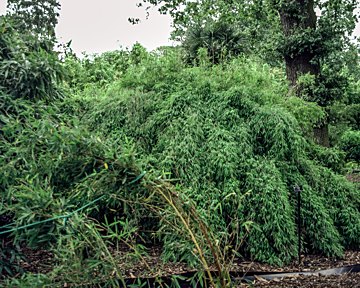
In this paper the place of publication of the name Arundinaria nitida is accepted as the Gardeners’ Chronicle in 1895. No type was designated, but a picture of a clump in the Bamboo Garden at Kew was printed. A herbarium collection of Arundinaria nitida with vegetative parts from the Bamboo Garden, placed in the herbarium in 1895, is designated as a neotype (a new type). Another collection, made in 2000 after a clump started flowering at Kew, is designated as epitype (supporting the type). I photographed the clump at Kew in 1999 just as it started flowering (see left), and the location, in front of a slanting oak tree, is highly suggestive of it being the same clump planted in 1895 as illustrated in Gardeners Chronicle.
As the seed of this species was collected in China and sent to the west in 1886, it is sobering to think that it has taken 129 years to sort out its name properly.
Apr 2015: Stabilisation of temperate bamboo names
To demonstrate how temperate bamboo names are becoming stabilised in western horticulture, despite many muddles and misapplications, a presentation was given to Hortax, the Horticultural Taxonomy Group, at the 1st European Horticultural Taxonomists’ Forum at the RHS Gardens at Wisley. The development of our knowledge of genera, and the causes of some of the problems that need to be addressed, were presented. The path to a more stable, consensual classification system was described, highlighting the importance of Dieter Ohrnberger’s Bamboos of the World, the American Bamboo Society Source & Species Lists, and the Flora of China Bamboo Account.
Aug 2013: New generic names for bamboos from Africa
Two bamboo species from Africa are in cultivation in western horticulture. A bamboo from Southern Africa previously known as Thamnocalamus tessellatus has been in western cultivation for over a century, and is widely planted for its relative drought and wind tolerance, and its striking white sheaths in the early summer. A bamboo from equatorial latitudes across Africa previously known as Yushania alpina is a more interesting species. It has only been introduced relatively recently and is not yet widely grown, but has good potential because of its large culms, often with nodes ringed by short thorns, and there are even some plants with yellow-striped culms. It provides food for the threatened Mountain Gorilla, just as Chinese mountain bamboos provide food for the threatened Giant Panda.
These two species are quite similar to Asian bamboos, and not so strikingly different that they would automatically be recognised as distinct genera. Their separation has been confounded by the complexity of relationships between the Asian bamboos themselves.
DNA analysis of their positions relative to other temperate bamboos has now yielded sufficient evidence to confirm that they really do not belong in Asian genera. DNA studies I collaborated on as early as 1994/5 with Prof Xia Nian-he including T. tessellatus, and in 1999/2000 with Dr Gráinne Ní Chonghaille, including Yushania alpina, had suggested that these species were not closely related to species from Asia supposedly in the same genera. Later studies have reinforced their separation, with the eventual conclusion that they represent distinct lineages.
I have been looking closely at T. tessellatus clumps for over 20 years now, and I saw the introduced Y. alpina in Gold Beach, Oregon in 2002. I have slowly reached the opinion that the morphological characteristics are also sufficiently distinct for the description and naming of new genera, Bergbambos for B. tessellata, and Oldeania for O. alpina.
The origins of these African bamboos are not completely clear, but it is now thought that they diverged from common ancestors at the same same as Asian bamboos, when they all radiated out into new temperate habitats. They do not appear to have diverged at an earlier date, which would be expected if the Asian temperate bamboos had first evolved in Africa.
The endangered inhabitants of the species now known as Oldeania alpina on the mountains of Africa are very attached to their bamboo and they have also been studying it very closely. I’m sure they would agree that it is pretty unique.
Full text pdf
Nov 2009: Explanation of names used in Flora of China
Paper in Bamboo Science & Culture, Journal of The American Bamboo SocietY
The classification system and generic names applied in the bamboo account for the English language Flora of China are explained and justified in this paper. It presents some results of DNA investigations into the molecular phylogeny of Asian woody bamboos, undertaken by PhD student Gráinne Ní Chonghaile in Dublin, as summarised in the Classification section of this site, and reviews all the molecular data published by that time (2006).
It also presents an hypothesis to explain the distribution of temperate bamboos. It is suggested that they found it difficult to disperse to northern temperate areas from Gondwanaland in the Southern Hemisphere, where they first evolved, and only reached Asia relatively recently. They seem to have then exploded in diversity as they expanded across E Asia. First, however, they had to slowly cross the tropics on moving mountains in what is now Africa or India, to spread into Asia only after the collision of tectonic plates.
Full text
Sep 2007: New names for some Nepalese bamboos
Paper in Journal of The Botanical Research Institute of Texas
As a step towards publishing an updated version of the Bamboos of Nepal, some changes have been made to the names of a few bamboos from the Himalayas. In Thamnocalamus this has been necessary to bring the species in line with those of China and elsewhere, in terms of how different a bamboo has to be before it is called a separate species. Some bamboos known previously as subspecies have been formally elevated to species. This has given a more satisfactory treatment to the genus Thamnocalamus, which now has 5 species from the Himalayas, T. spathiflorus, T. crassinodus, T. nepalensis, T. chigar, and T. occidentalis.
In addition, it has become apparent that the name Himalayacalamus asper was being applied to two separate species. The name H. asper should henceforth be applied only to a bamboo from the area near the Annapurna mountains of Nepal, which is still very rare in cultivation in Europe. It was first introduced into France by Muriel Crouzet in 1992, and more recently by Jean Merret. The young culm sheaths are more distinctly rough rather than just pubescent, and the leaf sheaths have small ciliate auricles and broader blades. A second introduction of this species to France has recently been given the name Drepanostachyum merretii. The name H. asper takes priority however, as it was published in 1994.
As the type collection designated for the name H. asper was a collection from the Annapurna area, a new name, Himalayacalamus planatus, had to be given to the bamboo from Langtang, introduced into England by Merlyn Edwards in 1971, and previously cultivated in Europe & in the US under the names Arundinaria microphylla, Neomicrocalamus microphyllus and Himalayacalamus asper. The new epithet planatus, meaning level, reflects the very smooth culm nodes, which are scarcely raised at all.
When first considered a possible separate species and given a description in my 1991 PhD thesis, the name H. aequatus was coined, but it was not effectively published. That name has the same meaning as planatus but is harder to pronounce, and has consequently been dropped. The two species H. asper and H. planatus were merged together under the name H. asper in 1994 when H. asper was published, as the collections were not good enough to be absolutely sure that they were different species. The real H. asper was illustrated. Both of these species have become much better known while in cultivation in the west, and both have now flowered, so that vegetative and floral characteristics are known, and it is clear that they do indeed represent two separate species as first suspected.
The full paper is available online in the Biodiversity Heritage Library.
Mar 2007: Support for recognition of Cephalostachyum & Pseudostachyum
Paper in Taxon by Kunming Institute of Botany
An investigation into the molecular phylogeny of the subtropical genus Schizostachyum and its allies has been published in the international journal Taxon by researchers at the Kunming Institute of Botany in Yunnan. This follows their investigations into temperate bamboos reported in the classification section. Using two different genes they inferred relationships between representatives of these genera, and showed that there is strong justification for recognizing Cephalostachyum & Pseudostachyum as separate genera distinct from Schizostachyum.
Holttum, a British botanist working in Malaysia, later to become famous as a fern taxonomist at Kew, first suggested that Cephalostachyum, Teinostachyum & Pseudostachyum should be merged into Schizostachyum, and this was followed by many later authors, including Clayton & Renvoize at Kew in their overview of the grass family in 1986 and by Majumdar and others in India to this day. On the other hand, the smaller genera continued to be recognized by some others, for example in my treatments of Himalayan bamboos, and we followed this approach in the Flora of China. This latest research from China supports that decision, and also the recognition of smaller genera rather than larger groups, which are tending to be revealed as polyphyletic (descending from more than one common ancestor) by molecular analysis through DNA sequencing.
Summary of paper online
Aug 2006: New treatment of native American bamboos
Paper in Journal SIDA describing a new, third species
Arundinaria appalachiana has just been described, bringing the total number of native N American bamboos to 3. After being advised by grass taxonomists, Floyd McClure in 1973 interpreted the bamboos native to the SE United States as a single species, A. gigantea, with two subspecies gigantea and tecta, and a hybrid between them, a treatment that has been followed for the past 30 years. Recent fieldwork, applying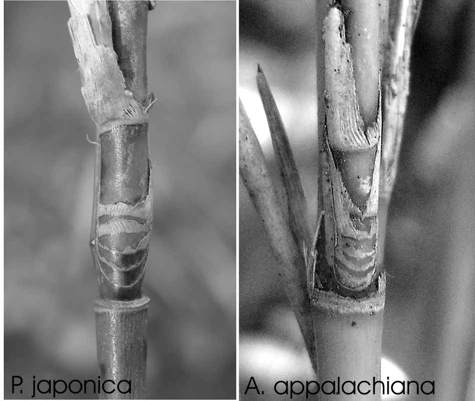 a better understanding of the importance of their vegetative characters such as the branching, backed up by molecular analysis, has shown that it is much more appropriate to go back to two full species, Arundinaria gigantea, River Cane or Giant Cane, and A. tecta, Switch Cane. a better understanding of the importance of their vegetative characters such as the branching, backed up by molecular analysis, has shown that it is much more appropriate to go back to two full species, Arundinaria gigantea, River Cane or Giant Cane, and A. tecta, Switch Cane.
Hill cane, a smaller stature bamboo previously named as A. tecta var. decidua Beadle is described as a third, new species A. appalachiana Triplett, Weakley & L.G. Clark, indigenous to areas away from streams in the S Appalachian mountains.
What is most interesting to me is the similarity in appearance of the branching of the new species, A. appalachiana and that of Pseudosasa japonica from Japan (see right: P. japonica photo by C. Stapleton cf. A. appalachiana photo by J. Triplett). P. japonica has been resolved as the closest Asian relative of the native N American bamboos in recent molecular studies. This similarity in branching supports the molecular results. It also gives further indirect support to the recognition of the genus Sarocalamus. The inclusion of its species from W China and the Himalayas in Arundinaria along with the native N American bamboos, is hard to justify if nearly all other Asian bamboos, including Pseudosasa japonica, have been excluded (see item on Flora of China bamboo account below).
The paper is online at:
http://www.biodiversitylibrary.org/item/34586#page/87/mode/1up
“The BRIT Press believes that botanical knowledge should be shared freely among all those interested. In support of this belief, we recently made our complete journal archives of Sida, Contributions to Botany free to the public through an online sponsor, Biodiversity Heritage Library.”
Aug 2006: New names for cultivated species
Paper in journal SIDA describing a new Chinese species and other taxa
Several new names for bamboos in cultivation in the west have been published. They include Fargesia apicirubens, an apparently previously undescribed species from W China, which has been misidentified as F. dracocephala in cultivation (the real F. dracocephala having been grown as Fargesia sp. ‘Rufa’). Drepanostachyum falcatum var. sengteeanum is a new variety of the elegant D. falcatum from the Himalayas. Borinda angustissima, Borinda contracta, Borinda nujiangensis and Borinda utilis are all new combinations for species previously described in the genus Fargesia, but moved to Borinda on account of their flowers, vegetative characteristics or DNA sequencing. Indocalamus hamadae is a new combination for the interesting Japanese bamboo which has many characteristics distinctive of the otherwise Chinese genus Indocalamus, such as very large leaves, but has up to 3 branches rather than the solitary branch seen in the Chinese species.
The paper is online at:
http://www.biodiversitylibrary.org/item/34586#page/339/mode/1up
“The BRIT Press believes that botanical knowledge should be shared freely among all those interested. In support of this belief, we recently made our complete journal archives of Sida, Contributions to Botany free to the public through an online sponsor, Biodiversity Heritage Library.”
Jul 2006: Publication of the Flora of China Bamboo Account
Collaborative treatment of Chinese woody bamboos in Vol. 22 Poaceae
The bamboo account for the English language Flora of China has been written, edited, and rearranged to follow a classification system that could be accepted by the Chinese authors and non-Chinese bamboo authorities, including myself as the non-Chinese co-editor. The treatment has seen the relegation of Sinarundinaria into synonymy within Fargesia and the recognition of many genera instead, such as Yushania, Himalayalacalamus and Drepanostachyum, which were not recognised in the Chinese language FRPS account, nor in the draft English version prepared by the Chinese authors. I felt justified to make these changes on molecular and morphological evidence. The genus Borinda has remained within Fargesia, for the time being, as we know there are many species currently placed in Fargesia that are likely to need to be removed, because their flowers are very different to those of the type species. Without further investigation however, we do not know which ones. This way at least the Borinda species are all in the same genus, where they can stay temporarily until we know more about which ones to move from Fargesia into Borinda. The genus Sarocalamus has remained within Arundinaria, as the molecular evidence suggesting that it has little connection with Arundinaria is as yet not very strong, while morphologically it is undoubtedly very similar. One surprising action, an unfortunate change made after the account had left my desk, and without my knowledge, is the adoption of the name Phyllostachys reticulata instead of P. bambusoides. I am not happy with that decision, as the name P. reticulata is not adequately typified. From its description it does not even sound like a Phyllostachys species at all, and we may never know which species its author had in mind. The name P. bambusoides is in such widespread use for an economically extremely important bamboo that it should be conserved against the earlier name P. reticulata anyway if, and that is a big if, the two names are ever shown to represent the same species.
The account can now be accessed online with all the keys functional (scroll down below the tribal description to get to the generic key, which is linked to genera and species accounts), or as a single pdf file to save locally and use offline.
Jun 2006: Bamboo Phylogeny Group
NSF-funded project at Iowa State University & Idaho State University
Several recent investigations into the relationships between bamboo genera have been undertaken using modern techniques of molecular and morphological comparison. They have resulted in elucidation of some of the relationships. This has allowed development of classifications systems which are hopefully largely natural, such as that applied in the Flora of China bamboo account. However, they have been limited by the breadth of coverage of different genera and the use of different techniques in different studies. To address these shortcomings Lynn Clark of Iowa State University and Scot Kelchner of Idaho State University have obtained funding from NSF to work with colleagues from around the world in a group investigation that will cover a larger selection of bamboos in a more directly comparable fashion. A website has been established to allow contributors to standardize their coding of morphological characters. Results of the investigations will be posted on the website and it is intended that it will be expanded to link to other sources of information.
Meanwhile recent investigations into molecular phylogeny of Asian woody bamboos have been evaluated, and some recent trees have been posted on this site as the basis for the best currently available phylogeny and classification of woody bamboos.
May 2004: Bamboo Conservation
Launch of INBAR/UNEP reports
A joint investigation by INBAR (International Network for Bamboo and Rattan) and WCMC (World Conservation Monitoring Centre of UNEP -United Nations Environment Program) into the distribution of wild forest bamboos has been undertaken. This has highlighted their vulnerability to deforestation and the likelihood of extinctions. Their conservation is of great concern to INBAR & UNEP, who hope that further studies will be made to improve knowledge of their taxonomy, distribution and conservation status.
The first report into the conservation status of bamboos of Asia, in 2003, identified and quantified this problem. We also raised this issue in a paper in the journal Biodiversity & Conservation. A second report last year confirmed that the same situation prevails in Africa and S America, making this a problem of global dimensions.
The 2 reports are both available online from UNEP, but they are large files, lavishly illustrated with maps showing remaining forest areas that potentially could contain bamboos:
Report 1-Asia at BHL (big file)
Report 1-Asia at ourplanet.com (smaller file)
An even more compact (2Mb) version of the first report without the species maps is available here.
Report 2 -Africa & S America at BHL (big file)
Report 2 -Africa & S America at ourplanet.com (smaller file)
|



















 "Mystery bamboo shoots 1")
 "Mystery bamboo shoots 2")
 "Image colour corrected01 LR2 50-360")