|
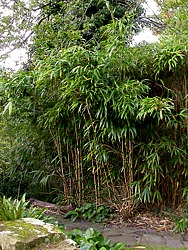
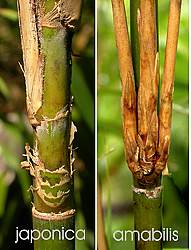
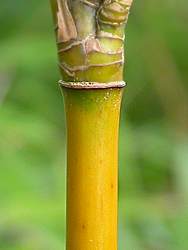
Plants shrub-like, spreading and densely clumped; rhizomes leptomorph, tillering. Culms 0.5–13 m tall, to 4 cm in diam., self-supporting, erect or nodding, pluricaespitose; internodes mainly terete, only slightly flattened immediately above the branches, glabrous, with light wax below nodes; nodes not or slightly swollen, supranodal ridge not evident. Branches initially 1–3 branches, erect to arcuate, often short; central dominant, basal nodes compressed, lateral branches arising either from basal nodes (P. japonica) or from more distal nodes, branches fully sheathed, sheaths and prophylls more or less glabrous, persistent, tough; buds tall, closed at front, 1 to 3 initials visible within, prophylls 2-keeled. Culm sheaths coriaceous and very persistent; blades erect or reflexed, narrowly triangular to strap-shaped. Leaf sheaths persistent; blade tessellate, medium to large for size of culm, without marginal necrosis in winter, arrangement random. Synflorescence an open raceme or panicle; branching subtended by much reduced or quite substantial bracts. Spikelets 2–20 cm, with 3–30 florets, rhachilla sinuous; disarticulation below the florets. Glumes 2, shorter than the first lemma; lemmas to 1 cm; stamens 3; stigmas 3; paleas 2-keeled. Name after the exclusion of the first species published from the similar but 6-stamened genus Sasa.
Around 36 species are currently assigned to Pseudosasa, originating in Japan, China, and Korea. The Japanese type species, P. japonica differs from the rest of the genus (Subgenus Sinicae) by having very persistent culm sheaths and a solitary spreading branch at each node rather than 3 very erect branches.
|